Afr on a 2012 Road Glide Doesnt Read
How Information technology Works by Dr. Dyno, American Iron Mag, July 2010
In The Loop
Dr. Dyno explains 02 sensors and airtight-loop systems
Last month the good medico brought us upwards to date on the latest dyno models and how six-speed Harley transmissions touch on dyno testing. This month he explains the operation of the often-misunderstood oxygen (O2 ) sensor-based, closed-loop fuel-injection system that was rolled out on the Dyna models in 2006 and has been standard on all Harley models since 2007.
Last AUGUST, I HAD ONE OF THOSE One time-IN-A lifetime experiences. My dyno was set up where I've run it for years, a few miles eastward of Sturgis at an intersection just beyond the mode from the Full Throttle Saloon. On the evening of Friday, August 7, that intersection must accept been the epicenter of a killer Bicycle Calendar week hailstorm. The dyno survived, but my pickup and slide-in camper took a chirapsia. The camper was totaled, and the truck extensively dented. Some timely phone calls got me a new windshield, but past Daytona Bike Week 2010, I still hadn't gotten the dents fixed.
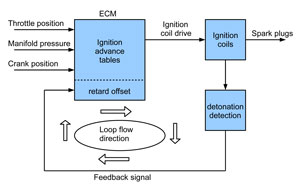
Harley'southward Delphi antiknock ignition system is a basic, closed-loop feedback system. Any detonation is detected and eliminated within a few engine revolutions.
At Daytona, I came beyond Wayne Walker, aka the Paring Ranger. Turns out he rides a 1999 Indian Principal that was running poorly at the time, to say the least. His expertise is paintless dent removal; mine'south tuning motorcycles. Approximate y'all tin can see where this is going. The Paring Ranger had spent good money at diverse cycle shops only to accept the Chief running almost as good as a papoose. The bicycle looked great, but the jetting was way too rich, so I adjusted his Due south&S Super East down four jet sizes. Later, the wheel ran well on the dyno and, according to Wayne, was "running meliorate than it always has." He and then questioned me about the jetting. Wayne said the 74 jet the Super Eastward had in information technology was the normal jet for the bike, which was info that probably came from one of the guys who tuned information technology before. I explained that the jet I put in was spot-on for the restrictive stock muffler on the bike. The normal jet killed the Indian's functioning in the same style closed-loop fuel injection can accept the life out of Twin Cams and Sportsters. In stock form, they're oftentimes anywhere from a piddling to a lot lean, making them run hot, sluggish, and far from perfectly. In my opinion, every unmarried one needs tuning, simply dealers say they're running normal. I telephone call it EPA normal and in need of handling. True, many of the therapies I'll mention will exist for racing, off-road, and closed-course applications, simply in many cases, we've already stepped over that line merely by changing mufflers or air cleaners.
SENSORS AND LOOPS 101
If you don't understand this O2 sensor, open- and closed-loop stuff, you'll be a sucker for guys who use them as buzzwords with the intent of opening your wallet. Let'south commencement the lesson by taking a await at some other airtight-loop system that does its job so well on Twin Cams that nosotros rarely fifty-fifty notice it: the antiknock ignition system. Information technology has several inputs, as shown in the diagram above. From them, the ignition department of the cycle's electronic control module (ECM) continuously outputs the proper spark advance and timing from its advance charts. And so far, we accept a basic system that works well, only tin't optimize timing for fuel octane or compression changes. To reach that, we add together what'south known in electronics every bit feedback, where a sample of the output is fed back to the processor. When drawn on a diagram like the 1 hither, the information menses looks like a circumvolve or a loop. It's called closed-loop to distinguish information technology from open-loop, which is when feedback is not used. In the closed-loop ignition system, the feedback indicate is generated by a detonation detection circuit and used to retard the ignition system as needed. The process goes on continuously and is unnoticed by the passenger, except when he may hear a momentary pinging as the system adjusts to load and throttle changes. Wouldn't information technology be nice if the fuel system was as transparent?
The fuel arrangement adds head and intake air temperatures as inputs to the ECM. Throttle position is measured at the throttle body on the engine (2008 and later Touring models take an electronic throttle so the position may lag in the passenger's throttle hand). The top department of the fuel organisation diagram below shows the system used on all non-O2 Delphi EFI Twin Cams. The cam position sensor times the injector pulse and the fuel tables set the fuel injector's pulse length and, therefore, the volume of fuel injected. The fuel tables are lists of pulse lengths based on throttle opening, manifold pressure level, and engine rpm. When combined with the ignition tables, they're often chosen maps considering the ECM is constantly moving around on them as the bike is ridden. The basic fuel tables are set to produce air/fuel ratios (AFRs) of most 14:1 at low throttle openings, gradually getting richer as the throttle is opened to 13:i at full throttle. This gives good fuel mileage, responsive performance, and maximum horsepower. The intake and head temperatures commencement the tables, adding a little more fuel to keep the engine running smoothly when either the engine or conditions is cold.
Enter the O2 sensors and airtight-loops in 2006. Why were they added? Some people will say they were added to help the bicycle conform for conditions and altitude changes. Absolutely not! Every bit a matter of fact, equally we'll run into shortly, the opposite is truthful. Plus, didn't we merely run into that the pre- O2 system already adapted for temperature? And altitude is automatically tracked since atmospheric force per unit area changes show up at the manifold pressure sensor. No, the O2 sensors were added for 1 reason only: to control frazzle emissions the same way they have on cars and trucks since the 1980s. They allow for that good former 14.7:1 stoichiometric AFR that yields the most complete combustion and thus minimum emissions. Y'all may also see the 14.six:1 AFR used in various places. Close plenty, they're interchangeable. When I first wrote about going to 14.7 in the autumn of 2006, information technology seemed like a practiced idea. Simply, slowly, we started to see the downside: heat and lots of it. The summer of 2007, when the O2s made their style into all models, was a particularly hot one for new Harley owners. Owners were adding fans and oil coolers. They were going to true dual exhausts on Touring models just to become rid of the rear pipe's oestrus radiation on the correct side. When the Motor Visitor realized the scope of the heat problem, information technology added the parade mode, which shuts down the rear cylinder at idle. Then, in 2009, Harley routed the exhaust nether the frame. The problem is that the heat source is withal there, and the air-cooled engine has no good way to command information technology or, as I say, to turn off the toaster.
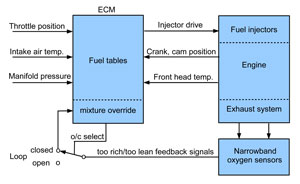
This is the ECM fuel section used on the 2006 Dynas and all models from 2007 to present. In closed-loop mode the O2 sensors override the fuel maps that otherwise would recoup for temperature and altitude.
Let's look once more at the fuel system diagram to encounter what's happening. At the bottom are the O2 sensors, one per cylinder, the same kind found on virtually cars. They're mounted in the exhaust pipes where they detect the amount of O2 in the frazzle gases, a direct measure out of the AFR during combustion. The sensors are referred to as narrowband considering their output changes very little in the AFR exterior the narrow range of 15:one to 14.2:i. It would also be accurate to call them switches since they effectively toggle on and off abruptly as the 14.7:ane ratio is crossed. I labeled their output too rich/too lean because in performance, the fuel system can't really maintain the 14.seven:1 ratio and so information technology's continually hunting. If the mixture is detected as leaner than 14.7, the ECM responds by calculation fuel at the injectors. That makes it too rich at the exhaust, so the ECM reduces fuel. One time the loop is closed and this hunting process starts, the loop is referred to every bit locked, and it repeats continuously as long as the loop is closed. This hunting arroyo may seem somewhat peculiar, simply it'due south the way it's been engineered on cars for over 30 years. As for the feedback, instead of information technology resulting in offset every bit on the ignition system, it results in what I call override. In airtight-loop fashion, the O2 sensors don't arrange the fuel maps. Instead, they completely take control away from them, causing the temperature and pressure sensors to take no upshot either. Rather than compensate for the weather, as some claim, the airtight-loop system ignores it. The cycle runs lean to begin with, and, as i rider told me, the colder it gets, the worse information technology runs. That'due south considering it doesn't get the extra fuel it needs for the higher density air. Under preprogrammed control of the ECM, the loop switch can be closed or open. The switch ends upward in the closed position the bulk of the time because the bike is most frequently idling or cruising. It's open up and running on the fuel tables for a short simply of import time during dispatch, and at what I telephone call top terminate, which is in a higher place three-quarter throttle or three-quarter maximum rpm. During deceleration, the fuel should be turned off for minimum emissions, just Harley does not seem to do that all the time, resulting in the infamous decel pop. In whatsoever example, it'due south open-loop on deceleration.
A CASE STUDY
The AFR graph below shows a 96" Road Glide running at about 1-quarter throttle and making 25 hp during my cruise test. As I held it at about 1400 rpm, it ran closed-loop at 14.7:1. When I twisted the throttle one-quarter open, notice that the rear cylinder (red) went a little lean, running open-loop on its fuel tabular array during the acceleration. Whatsoever bacteria and we would accept had a stumble. At a steady, one-quarter throttle, we can see the hunting action that averages to xiv.7 as nigh as we can tell. Although the engine would be happier closer to fourteen.0, 14.vii isn't too bad at quarter throttle and 25 hp. The problem is, information technology will all the same be that lean at three-quarter throttle while trying to make 60-plus hp. At those power levels, things get real hot, real fast due to serious fuel starvation. And await what happened when the ECM opened the loop at 4600 rpm. The forepart cylinder (blue) headed right for thirteen:i, exactly what we want to see, merely the rear headed for meltdown. It's interesting that at total throttle (not shown), which is open up-loop at all rpm since it's over three-quarter throttle, the rear cylinder AFR ran closer to the target xiii:1 than the front. Does this mean the system learns, allowing united states of america to alter airflow components with impunity and it will adjust? Well, yeah and no. Every bit long as the changes are small enough, such as air filter and pipes, the arrangement will even so be able to attain xiv.seven. However, that doesn't change the fuel tables the hunting starts from, meaning it hasn't actually learned. With a large enough change, such every bit cams or cubes, not only will the open up loop tables exist way off, closed-loop lock may not exist doable either.
FIXES FOR 02-Caused Heat
What we've seen is that the O2 sensor equipped Twin Cam and Sportster models run in 2 separate and distinct modes, closed-loop on the sensors at idle and cruise, and open up-loop on their fuel tables or maps on dispatch and at top end. If you can alive with "normal," your bike's engine can, also. And with constructed oil, the engine won't go hot enough to hurt itself.
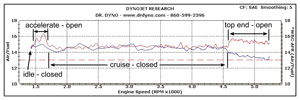
This typical AFR graph done at a 25 hp cruise shows the open- and closed-loop areas of performance. It's lean at idle and cruise where information technology hunts for 14.vii:1 and extra lean on the rear cylinder (ruby) at both ends.
And so what's the plug-and-play quick set? With our newfound smarts we should be able to figure this out, or at to the lowest degree split up the tuning products from their promises. This is an open up-book examination so experience free to review the fabric as many times as needed. Just be enlightened that every company's ads tell you what the product is supposed to exercise, but never what it won't practise. How almost what I call the O2 off-setters that plug into the sensor'south circuit and reset the AFR to 14.two:1 or 13.7:1? Showtime, they work only during closed-loop, which ways they tin't help an off-idle lean stumble or work at top stop. Merely most of our riding is done at idle or cruise where they will work. All the same, since they use the stock, closed-loop system, nosotros're stuck with one AFR from lite to three-quarter throttle. However, fourteen.2 is definitely meliorate than fourteen.vii. An AFR of thirteen.7 is a little rich to get the best mileage, and it gets shaky because we're working over the electronic edge of a narrowband sensor. This may have you asking "Why not simply supercede the narrowband sensors with wideband ones that can accurately measure the whole range of AFRs?" There are two reasons non to. Showtime, it's not a simple swap since wideband sensors require an electronic interface box. Second, nosotros'd withal have simply one AFR for the unabridged cruise throttle range. The right use for wideband sensors is with the autotune systems, simply that'due south for the next commodity (September).
Street-legal tuning products are available for closed-loop bikes, only keep in mind that they but work in the open up-loop surface area. Two such products are the Dynojet Ability Commander III EX and the Vance & Hines Fuelpak EX. A description of Fuelpak EX I plant on www.Fuelpakfi.com explains that it "works in conjunction with your motorcycle'due south mill oxygen sensors and provides improved fuel delivery at higher rpm and throttle openings." In a way, information technology explains what the Fuelpak doesn't exercise: it doesn't change idle or cruise because it doesn't bypass the oxygen sensors. Occasionally, someone brings me a Harley with a PCIII-EX he bought considering it was the newest model at the time, and it's street-legal. I replace it with a PCIII-usb, install the O2 eliminators, and dyno tune the bike as if it was pre-O2 vintage. Information technology'll run perfectly, and someday he wants it to run across emissions, the owner can simply reconnect the O2 sensors.
Lastly, there'southward the whole area of software tuners that change the programming inside the bike'due south ECM. The sky's pretty much the limit with these types, both skilful and bad. It takes hours to get information technology only right, just a proficient tuner can make a bicycle run perfectly. To go far run terriblely just takes a few minutes. The problem for the customer is, dissimilar an external device such as a Power Commander, the cycle'south ECM is write only and so the maps can't be read from the ECM. The only place where the changed ECM data is stored is in the tuner's computer. Unless he gives y'all a copy on a memory stick, it's start over for any other tuner who might piece of work on your bike. A good tuner won't requite you lot the maps because they'll get passed around for free or sold, costing him business. Of course, lesser tuners don't want anyone seeing their bad maps either. And neither ane will tell yous they're going to lock you lot in up front, so you need to exist especially confident about who you let to mess with your cycle'south ECM. AIM
halpernsioned1976.blogspot.com
Source: https://www.drdyno.com/AIM_2010-07.html

Post a Comment for "Afr on a 2012 Road Glide Doesnt Read"